main page — CS 594 Algorithms of Bioinformatics
Unit 6: Suffix Trees
This unit covers suffix trees and their applications in bioinformatics.
- suffix trees
- longest common substring problem
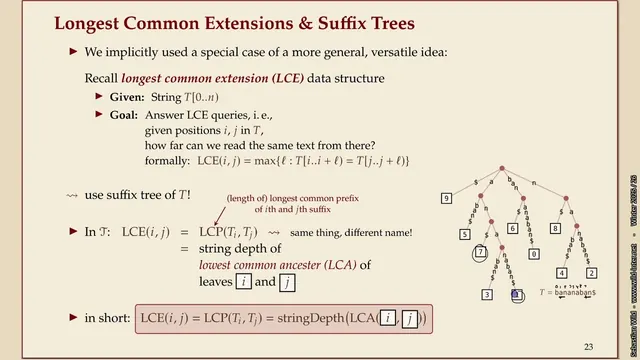
- longest common extension problem
- suffix arrays
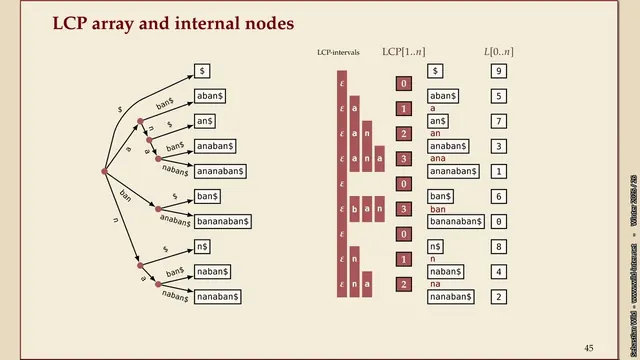
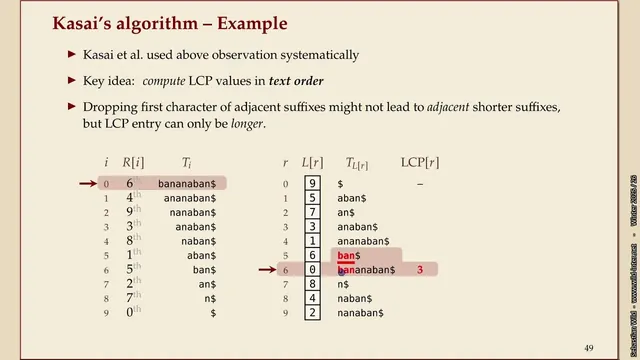
- LCP arrays
Material
- slides
- Video 6-1 (2025-12-11, 18:38):
Suffix trees
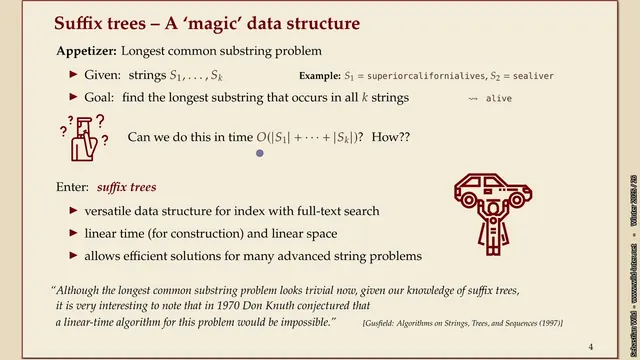
- Video 6-2 (2025-12-11, 13:01):
Suffix tree applications
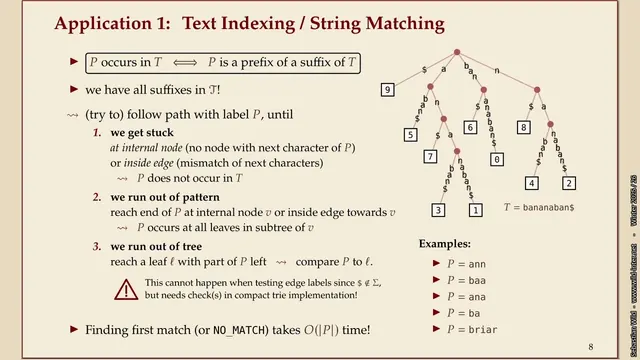
- Video 6-3 (2025-12-18, 25:32):
Generalized suffix trees
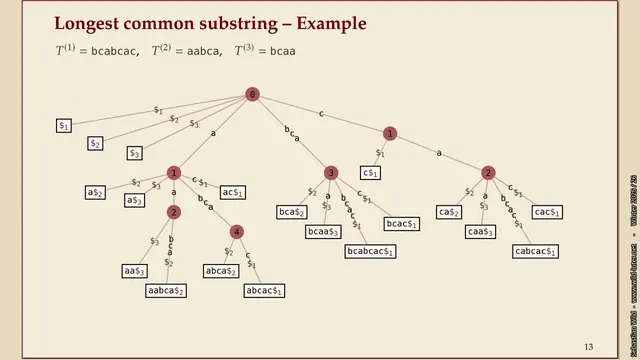
- Video 6-4 (2025-12-18, 25:01):
Tandem repeats

- Video 6-5 (2025-12-18, 7:24):
Longest common extensions and suffix trees
- Video 6-6 (2025-12-18, 25:27):
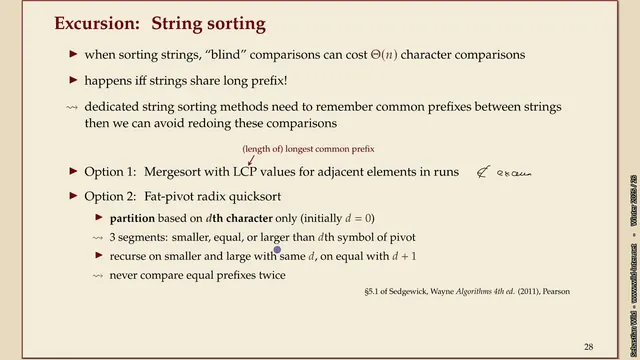
Suffix arrays and string sorting
- Video 6-7 (2026-01-15, 14:52):
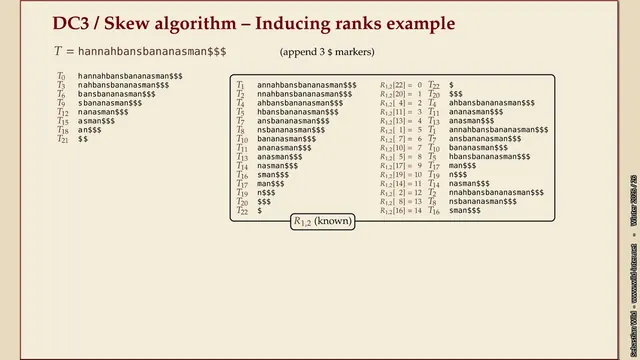
DC3 suffix array construction: induced sorting and merging
- Video 6-8 (2026-01-15, 16:10):
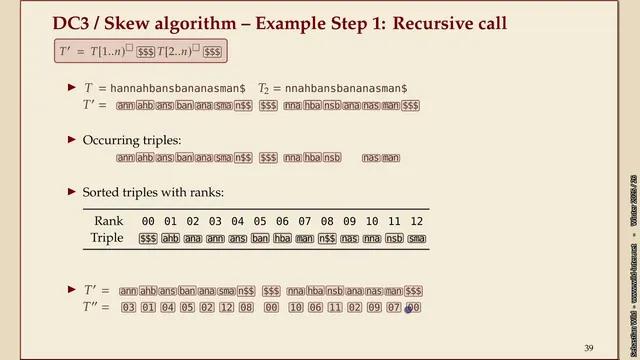
DC 3 suffix array construction: final algorithm
- Video 6-9 (2026-01-15, 18:48):
The LCP array
- Video 6-10 (2026-01-15, 11:10):
LCP array construction
Further sources
Tries are notoriously treated only in passing in most algorithms and data structures textbooks, and there are various little differences in the details. Apart from the fact that they do not insist on prefix-free keys, I find the most helpful treatment of tries is given by Sedgewick and Wayne:
- Sedgewick, Wayne: Algorithms 4th edition (2011), Pearson
- Algorithms 4th ed booksite
Suffix trees:
- Gusfield: Algorithms on Strings, Trees, and Sequences (1997) Cambridge University Press
- Crochemore, Rytter: Jewels of Stringology (2002), World Scientific
Suffix arrays have not yet found widespread inclusion in standard textbooks; my way of presenting it is mostly my own, but took inspiration from
Suffix arrays and LCP arrays are also discussed (in slightly different form) in
- Ohlebusch: Bioinformatics algorithms (2013) Oldenbusch Verlag