
main page — COMP 526 Efficient Algorithms
Unit 9: Range-Minimum Queries
This is an archived version of this module from Spring 2022.
Click here for the current iteration.
 This unit covers the range-minimum query (RMQ) problem:
- trivial solutions, sparse table
- longest common extensions in strings and RMQ
- linear-time preprocessing via exhaustive tabulation
Learning outcomes
- Know the RMQ problem and its connection to longest common extensions in strings.
- Know and understand trivial RMQ solutions and sparse tables.
- Know and understand the Cartesian trees data structure.
- Know and understand the exhaustive-tabulation technique for RMQ with linear-time preprocessing.
Material
- slides
- Video 9-1 (2022-04-25, 11:50):
§9.1 RMQ introduction
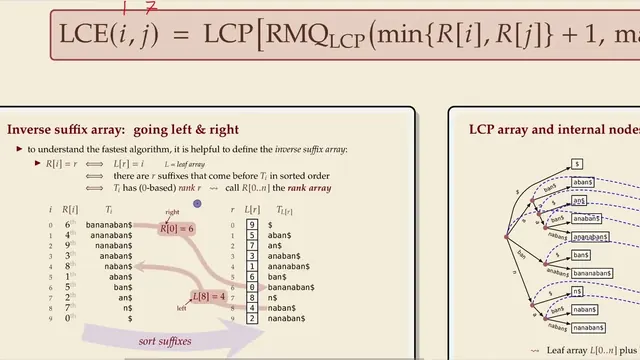
- Video 9-2 (2022-04-25, 12:43):
§9.2 LCE using RMQ
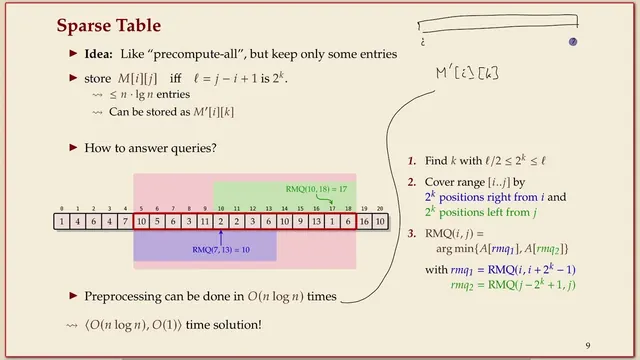
- Video 9-3 (2022-04-25, 16:09):
§9.3 Primitive RMQ & Sparse Tables
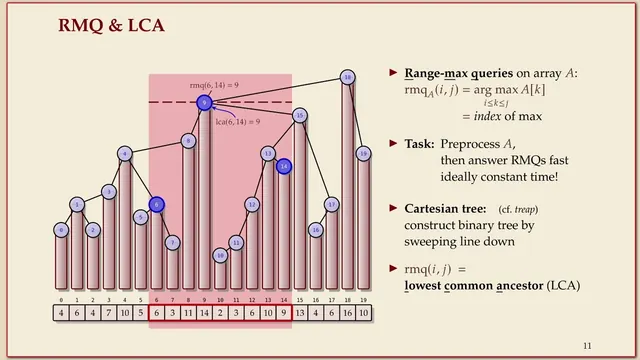
- Video 9-4 (2022-04-25, 28:24):
§9.4 Cartesian trees
- Video 9-5 (2022-04-28, 21:56):
§9.5 Exhaustive tabulation
Further reading and sources
The presentation is based on own work. It takes inspiration from the following paper on the related level-ancestor problem:
A more detailed exposition (with slightly different codes for the lookup table) appears here: